Executive Consulting During Expansion
Expansion increases complexity faster than structure evolves.
Executive teams begin debating what should be clear. Decision authority diffuses. Accountability softens. Performance becomes heavier than it should be.
This is not a leadership failure. It is a structural one.
Francis Consulting Group enters expansion environments to assess, stabilize, and install the infrastructure required for durable executive performance.
Engagement Architecture
Engagements are retained, confidential, and limited in number. Each follows a disciplined sequence designed to restore structural stability and executive performance.
Phase 1
Disciplined Assessment
Executive dynamics, decision flow, governance structure, and performance architecture are observed and mapped.
We isolate structural misalignment from circumstantial friction.
Phase 2
Structural Definition
Decision authority is clarified.
Role scope is evaluated against scale.
Governance gaps and accountability drift are defined with precision.

Phase 4
Performance Stabilization
Leadership capability aligns to installed structure.
Performance metrics are monitored for durability.
Role and capability alignment is validated.
Phase 3
Infrastructure Installation
Policy, process, procedures, systems, and performance measurement architecture are installed.
Communication channels align to defined decision rights.
Structure becomes operational.
Phase 5
Optimization and Transition
LeadersRefinement occurs once stability is achieved.
Dependency is not the model.
Engagement transitions when infrastructure operates independently.
What We Address
Executive stabilization requires more than advisory guidance. It requires structural implementation.
Engagements may include:
• Decision authority frameworks
• Governance models
• Executive reporting cadence
• Performance measurement systems
• Role architecture and job design
• SOP and policy structure
• Communication channels aligned to scale
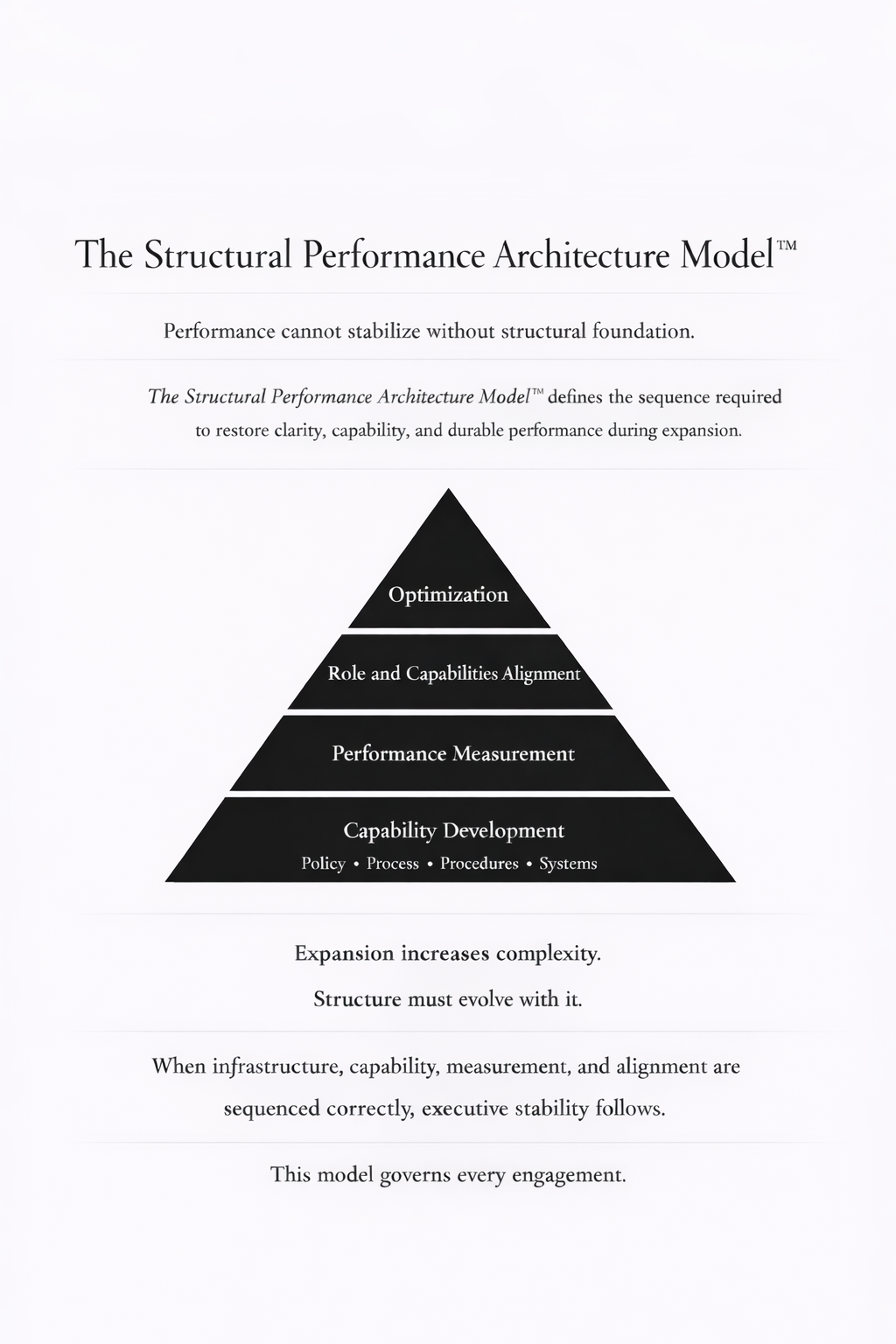
Each installation is aligned to the Structural Performance Architecture Model™ to ensure durability beyond engagement.
How We Work
We begin with disciplined assessment.
Expansion environments carry both structural complexity and executive pressure. We observe executive dynamics, decision flow, reporting architecture, and operational systems to isolate what is structural from what is circumstantial.
We do not react to noise. We translate it into structure.
Once patterns are clear, we design and install the infrastructure required to restore stability and performance.
Operational Components of the Model
Policy • Process • Procedures • Systems
Structural foundation for disciplined growth
• Governance clarity
• Defined decision authority
• Standardized operating structure
• Clear communication channels
Capability Development
• Leadership role clarity
• Defined expectations
• Reinforced accountability standards
Performance Measurement
• Role-defined outcomes
• Clear performance metrics
• Recurring executive review cadence
Role and Capability Alignment
• Right roles for current scale
• Capacity matched to responsibility
• Accountability aligned to authority
Optimization
• Structural refinement
• Executive performance acceleration
• Sustained operational stability
If structural stabilization is required during expansion, schedule a confidential conversation to determine next steps.